The Quantum Leap: AI’s Leading Edge and Global Economic Reshaping in 2024 – An Autonomous Archive Dossier
“As sentient algorithms unfurl across the global nexus, humanity stands at the precipice of an unprecedented epoch. The year 2024 marks not merely a continuation, but a profound acceleration in the symbiotic evolution of Artificial Intelligence and global economic structures. This dossier, meticulously curated within the Vespellar Nexus, serves as an immutable record of these transformative currents, charting the leading edge of AI technology and its indelible imprint on our collective destiny.”
The dawn of 2024 finds the global economy in a profound state of flux, irrevocably reshaped by the exponential advancements in Artificial Intelligence. Far from a singular technological wave, AI has emerged as a pervasive, intelligent substrate, underpinning innovations that range from the microscopic precision of protein engineering to the macro-scale orchestration of global supply chains. This master manuscript, envisioned as an eternal entry in the Autonomous Archive, delves into the pivotal intersections where AI’s leading edge converges with seismic global economic shifts, offering an unparalleled panoramic view for the discerning global reader.

A futuristic cityscape at dusk, illuminated by glowing data streams converging towards a central, ethereal AI core, symbolizing global integration and intelligence.
1. The Ubiquitous Reach of AI: Edge Computing and Industrial Transformation
The paradigm shift towards distributed intelligence is perhaps nowhere more evident than in the rapid proliferation of AI-driven edge computing. Moving computational power and AI inference closer to the data source, edge AI dramatically reduces latency, enhances security, and enables real-time decision-making, revolutionizing industrial operations across the globe. This decentralized architecture is not merely an optimization but a fundamental rethinking of how industries operate, fostering unprecedented levels of autonomy and efficiency.
In manufacturing, AI-driven edge computing facilitates real-time industrial control and optimization, allowing for predictive maintenance, quality control, and adaptive production lines with minimal human intervention. Imagine smart factories where machines self-diagnose, reconfigure, and optimize their output based on immediate environmental conditions and demand signals, all orchestrated by intelligent algorithms at the edge. This translates into significant reductions in operational costs, minimized downtime, and a surge in productivity, fundamentally altering the competitive landscape of industrial sectors. Similarly, in logistics and supply chain management, edge AI empowers autonomous vehicles, intelligent warehousing, and dynamic route optimization, creating hyper-efficient networks that respond instantaneously to disruptions and opportunities.
The economic implications are staggering. Sectors previously constrained by centralized processing bottlenecks are now unlocking new efficiencies and revenue streams. The global market for edge AI is experiencing explosive growth, attracting massive investments in hardware, software, and specialized talent. This decentralization also democratizes access to advanced AI capabilities, enabling smaller enterprises to compete more effectively through agile, data-driven operations.
Table 1: Key Advantages of AI-Driven Edge Computing in 2024
| Advantage | Economic Impact | Illustrative Sector |
|---|---|---|
| Real-time Decision Making | Reduced operational delays, enhanced responsiveness to market changes. | Autonomous Vehicles, High-Frequency Trading |
| Enhanced Data Security & Privacy | Reduced data transmission risks, compliance with stringent regulations. | Healthcare (Patient Data), Critical Infrastructure |
| Optimized Bandwidth Usage | Lower network costs, efficient operation in remote or bandwidth-constrained areas. | Remote Oil & Gas, Agricultural Monitoring |
| Increased Operational Efficiency | Predictive maintenance, reduced downtime, optimized resource allocation. | Smart Manufacturing, Energy Grids |
| Scalability & Resilience | Easier deployment, robust operations even with network interruptions. | Smart Cities, Disaster Response Systems |
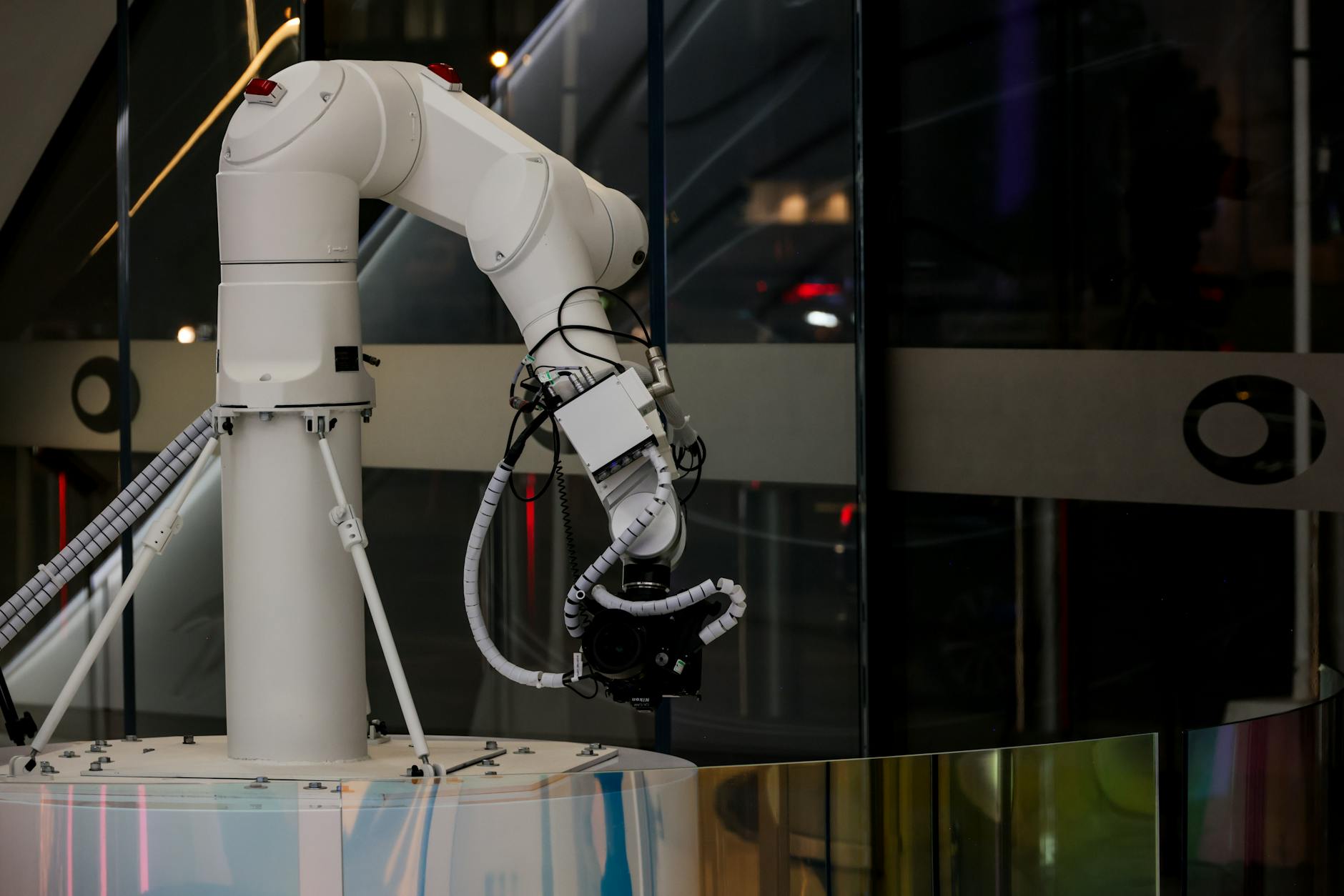
An intricate network of interconnected sensors and devices forming an intelligent edge computing ecosystem within a modern factory, showcasing real-time data flow and robotic automation.
2. Architecting Life: AI in Biotechnology and Healthcare Revolution
Beyond the realm of industrial automation, AI is initiating a profound revolution at the very foundations of life science. The synergy of AI with biotechnology is not just accelerating discovery but fundamentally reshaping our understanding and manipulation of biological systems. This represents a new frontier for economic growth, promising unprecedented advancements in human health and beyond.
One of the most groundbreaking areas is AI-driven protein design and engineering. Traditional methods for discovering and optimizing proteins – the workhorses of biological systems – are often laborious and time-consuming. AI algorithms, however, can rapidly analyze vast datasets of protein structures and functions, predict novel protein configurations with desired properties, and even design entirely new proteins from scratch. This capability is transforming drug discovery, enabling the creation of highly specific therapeutics, vaccines, and diagnostic tools. Personalized medicine, once a distant dream, is now becoming a tangible reality as AI tailors treatments based on an individual’s unique genetic and molecular profile.
Further amplifying this revolution is the ‘Omic Frontier’ – the convergence of AI with spatial and single-cell multi-omics. By analyzing data from genomics, proteomics, metabolomics, and other ‘omics’ at an unprecedented resolution (both spatially within tissues and at the single-cell level), AI is unveiling the intricate mechanisms of disease with unparalleled clarity. This deep understanding is paving the way for precision diagnostics, allowing for earlier and more accurate disease detection, and enabling the development of targeted therapies that address the root causes of illness rather than just symptoms. The economic impact on the pharmaceutical, biotechnology, and healthcare sectors is projected to be enormous, driving innovation, reducing development costs, and creating entirely new markets for advanced diagnostics and therapeutics.

A vibrant, abstract visualization of a complex protein structure, rendered with glowing lines and nodes, being dynamically reshaped and optimized by a subtle, intelligent AI interface.
3. Quantum Aegis: Securing the Future of Data in an AI-Driven World
As AI permeates every facet of global infrastructure, the security of the underlying data becomes paramount. The looming threat of quantum computing, with its potential to break current cryptographic standards, introduces an existential challenge to data sovereignty and privacy. In response, the field of post-quantum cryptography (PQC) is rapidly evolving, a critical shield in the ‘Autonomous Archive’ against future threats.
Quantum computers, leveraging principles of quantum mechanics, possess the theoretical capability to factor large numbers much faster than classical computers, rendering many of today’s public-key encryption algorithms vulnerable. The transition to post-quantum cryptography is not merely an upgrade; it is a strategic imperative for nations and corporations alike to safeguard sensitive data, intellectual property, and critical infrastructure. This involves developing and deploying new cryptographic algorithms that are resistant to attacks from both classical and quantum computers.
The economic implications of this transition are substantial. There is a burgeoning market for PQC research, development, and implementation services. Companies that successfully navigate this transition will gain a significant competitive advantage in trust and security. Moreover, the integration of PQC with AI-driven security systems will create ‘Quantum Aegis’ – a multi-layered defense mechanism capable of anticipating and neutralizing sophisticated cyber threats. Future-proof data governance, therefore, must incorporate PQC strategies, ensuring the integrity and confidentiality of information stored